Turn a Vague Skill Goal into a Practice Target
Turn a vague skill goal into a practice target by choosing one visible action, so each session has a clear focus and progress is easier to judge.
The common mistake with a skill goal is trying to practise the whole ambition at once: “get better at drawing”, “learn guitar” or “become a confident speaker”. That costs you a clear starting point and makes it hard to decide what a session was for. To turn a vague skill goal into a practice target, choose one action that fits the next session and can be attempted as written.
A practice target is not a timetable or a judgement of your ability. It is a temporary constraint: a specific action that keeps you from spreading attention across every part of a skill. Choose it by asking what the next session can reasonably help you decide.
Write a target that tells you what to do
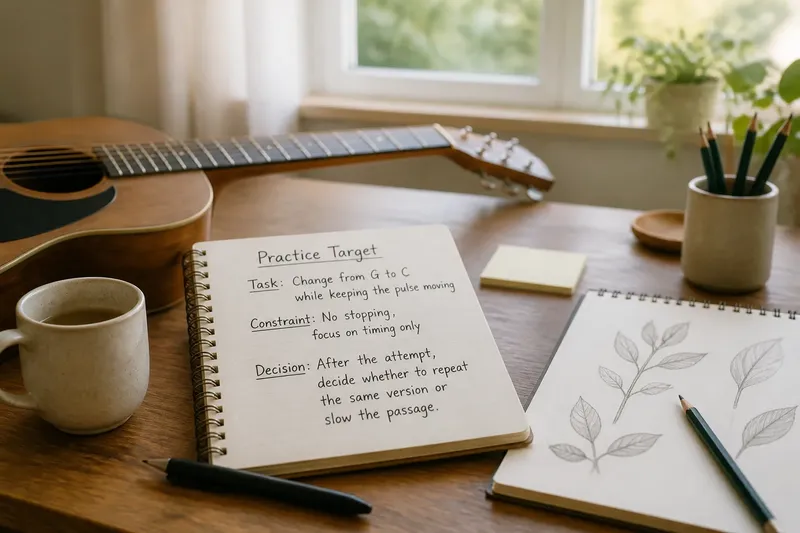
Begin with a verb and a task. “Improve my drawing” does not tell you what to do. “Sketch a cup, checking the rim and handle from the same viewpoint” gives you an action and a boundary. “Get better at guitar” is broad; “change from G to C while keeping the pulse moving” points to a defined task.
Use this simple structure:
- Task: name the thing you will work on, such as a chord change, a short explanation or a plant sketch.
- Constraint: say what you will include or leave out, such as keeping the pulse, using one linking sentence or drawing without adding details.
- Decision: specify what you will decide after the attempt, such as repeat the same version or simplify the task.
For instance, “Play the chord change without stopping; afterwards decide whether to repeat it or slow the passage” gives you a task and a next decision. It does not ask you to judge whether you are talented.
Read the sentence once before starting. If you need to interpret several clauses to know what to do, remove the extra instructions.
Use the session to answer one question
A target can be useful even when you do not know your weak spot. Instead of searching for a flaw, decide what you want the attempt to clarify. You might ask whether a transition is manageable at the current pace, whether an explanation makes sense without extra detail, or whether a drawing method gives you a shape you can work with.
Say you want to explain how to use a familiar piece of software. You choose the question, “Can I move from the problem to the solution in one clear sentence?” You prepare a short explanation, deliver it once, and listen for whether that link is present. If it is missing, your next target can be to write and practise that sentence; if it is clear, you can choose another part of the explanation to work on.
This approach gives a session a purpose without requiring a full diagnosis. Keep the question narrow enough that the attempt can inform a choice.
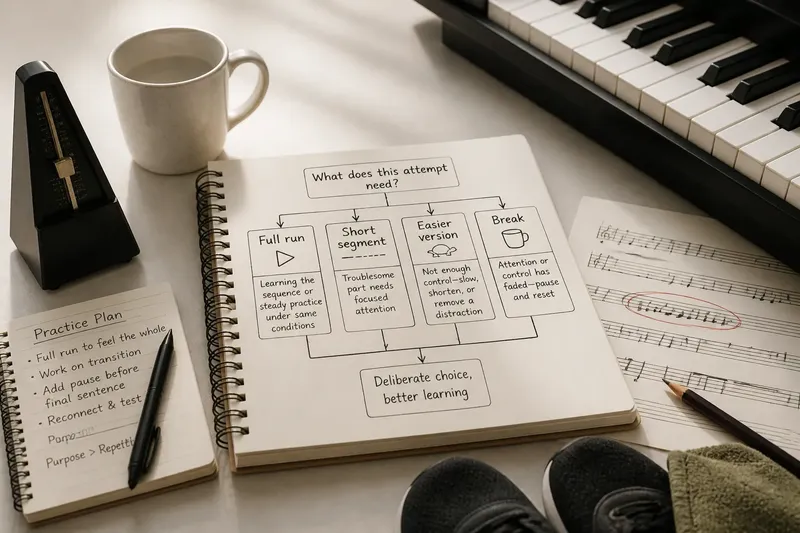
Choose a target by the kind of decision you need?
What if I do not know what to practise?
Pick a small task that lets you explore the skill, such as sketching one object or explaining one idea. Afterward, decide whether to repeat the task with the same approach or choose a different part to explore.
Should I practise the weakest part first?
Not necessarily; a weakness matters only if it affects the task you care about. Choose the part that is most relevant to your immediate aim, then decide whether it deserves another session.
How specific should a practice target be?
Make it specific enough to begin without inventing extra instructions, but not so narrow that it becomes disconnected from the skill. If the wording describes a tiny movement with no clear purpose, broaden it to include the task that movement supports.
When should I choose a different target?
Change it when the task no longer serves your aim or when you need a different question answered. A single awkward attempt is not, by itself, a reason to abandon the target.
Limit the session with a useful constraint
Skills often combine several demands. A song may involve timing, coordination and expression; an interview answer may need a clear point and relevant detail. Trying to work on every demand at once can turn practice into an unfocused performance.
Choose one constraint that makes the task manageable. For a song, you might leave expression aside and attend to the chord change. For an interview answer, you might practise stating the main point before adding supporting detail. The constraint is not a rule for all future practice; it keeps this attempt from becoming several tasks at once.
Imagine you are learning to sketch plants and want to make a page of leaves. You choose to draw only the main stem and the direction of each leaf, leaving shading and texture out. After the page, you decide whether those simple shapes are clear enough to add detail next time or whether you should keep working with the same stripped-back task. The result is a concrete choice, not a verdict on your drawing.
When several constraints seem useful, choose the one that removes the most distraction from the task.
Check the target before you begin
Use these checks to decide whether the wording is ready. Each result points to an action, so you do not need to polish the sentence endlessly.
- Can you start without clarification? If yes, begin; if no, replace abstract words with a named task and action.
- Does the target fit the skill you care about? If yes, keep it; if no, choose a task connected to your actual aim.
- Does it contain several unrelated jobs? If yes, keep the most relevant job and remove the rest; if no, retain the single focus.
- Can the attempt inform a choice? If yes, state what you will decide afterwards; if no, add a simple decision such as repeat, simplify or move on.
- Is the constraint so narrow that its purpose is unclear? If yes, reconnect it to the larger task; if no, use it for this session.
- Are you adding detail only to make the target sound impressive? If yes, cut the unnecessary wording; if no, leave the sentence as it is.
Write the final sentence on a sticky note, in a notebook or at the top of a document. Keep it visible, then start rather than continuing to revise it.
Leave a decision for the next session
After the attempt, write down what you did and the choice it leads to. “I stopped before the final chord change, so I will simplify the passage next time” is more useful than “bad practice”. “The link between problem and solution was clear, so I will work on the ending” gives you a different next move.
Imagine you planned to sketch a leaf using only its stem and outline. You complete the outline but find that the leaf’s direction is still unclear. Record the actual result—“the outline was finished, but its direction was hard to follow”—and decide to draw the stem and leaf shape separately next time. That note gives you a new task without pretending the first attempt answered more than it did.
Keep the record brief. If you could not complete the task or were interrupted, write that down and decide whether to repeat it or choose a smaller version. When turning a vague skill goal into a practice target, the useful endpoint is a clear next decision—not a perfect session or a sweeping judgement about your progress.