From Rehearsal to Deliberate Practice
Deliberate practice helps piano learners spend rehearsal time on the passages that interrupt a piece, with a clear method for studying a tricky transition.
The common piano-practice mistake is to restart a piece after every stumble. That costs attention on passages already secure and leaves little room to understand the difficult one. Deliberate practice gives the troublesome passage a different job: examine how it is built, then practise the musical elements that make it difficult.
Say Maya is learning a short piano piece for an informal performance. She can play the opening, but a quick right-hand figure after a left-hand position change repeatedly feels awkward. Instead of treating that moment as one mysterious failure, she maps the passage into its musical demands: reading, movement, rhythm and coordination.
Deliberate practice starts with a map of the passage
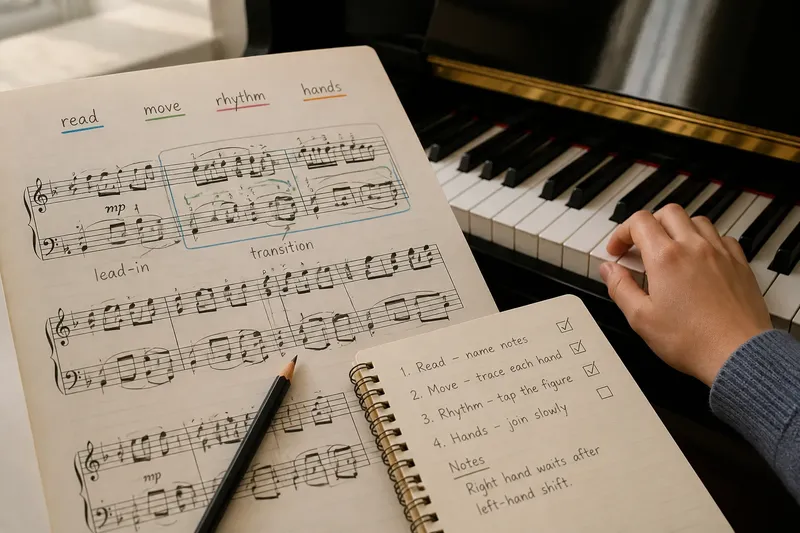
Maya marks the passage in her score, including the lead-in rather than only the notes where she stumbles. She writes four brief prompts above it: “read”, “move”, “rhythm” and “hands”. These are not four corrections to attempt together. They are possible sources of difficulty to inspect separately.
She first checks the notes and fingering in the score, away from the pressure of playing at performance pace. If the sequence is not clear on the page, repeating it will not resolve the uncertainty. She then silently traces the left-hand move and the right-hand starting position, so she can see whether either hand has an awkward route.
This approach differs from simply looping a short section. A loop may make the fingers more familiar with the notes, but familiarity alone does not explain whether the stumbling block comes from reading, movement, rhythm or the hands needing to act together.
Mark the passage that contains both the preparation and the difficult moment.
Separate reading, movement, rhythm and coordination
Maya checks one demand at a time. She names the right-hand notes from the score, then traces the left hand’s move without playing the whole passage. Next, she taps the rhythm on the piano lid. Finally, she brings the hands together at a pace that preserves the coordination challenge.
- Reading: If Maya cannot name the notes confidently from the score, then she pauses to clarify them before playing; if the notes are clear, then she moves on to check the hand movement.
- Movement: If the left-hand shift makes the right hand’s starting place hard to locate, then she silently traces each hand’s route; if both routes are clear, then she checks the rhythm.
- Rhythm: If tapping the figure exposes an uncertain beat, then she marks the beat grouping in pencil; if the rhythm feels settled, then she checks the hands together.
- Coordination: If each hand is clear alone but the joined passage still falters, then she tests a slower connected pace; if the hands stay aligned, then she checks the transition in context.
- Context: If the passage works alone but falters after the preceding phrase, then she includes more of the lead-in; if it connects cleanly, then she returns to a full run-through.
- Notation: If a fingering mark conflicts with a comfortable route, then she asks her teacher before changing it; if the marked fingering is clear and comfortable, then she keeps it while checking the next demand.
Each check produces a decision, not a verdict on Maya’s ability. If she can read and tap the figure but loses it when the hands meet, coordination is the next place to focus; if the notes themselves are uncertain, joining the hands is premature.
Build the passage from its musical components
Imagine Maya’s invented practice session starts with the score, a pencil and the marked transition. She names the right-hand notes correctly, traces the left-hand shift without hesitation, and taps the rhythm evenly. When she joins the hands, though, the right hand waits just after the left-hand change. Those observations point to coordination rather than note-reading or rhythm.
She keeps the same notes and fingering, but plays the lead-in and transition at a slower, connected pace. The expected sign is that the right hand begins without an added pause. If that does not happen, she will not add several new corrections; she will return to the separate checks and reconsider which demand is still unclear.
In this invented situation, Maya’s next attempt has a smoother start, but the last notes of the figure remain uncertain. She retains the clearer hand change and returns to the score to inspect those final notes. The result is a more specific next task, rather than another full-piece restart.
Keep the musical question small enough to answer through one kind of work.
Choose the next kind of practice?
How do you choose a passage to practise?
Mark the smallest passage that includes the lead-in, the difficult movement and what follows immediately. If the problem appears only when connected to the preceding phrase, include that phrase too.
Should you practise each hand separately?
Use separate hands when one part’s notes, fingering or movement is unclear. If both hands are clear alone but the joined passage breaks down, focus on coordinating them rather than repeating each hand without a reason.
What should you do if slowing down changes the difficulty?
Choose a pace that still contains the coordination or movement problem you need to hear. If the difficulty vanishes at a very slow pace, increase the pace slightly until the relevant challenge is present, while keeping the passage controlled.
When should you return to a full run-through?
Return to the whole piece when the passage can connect with its lead-in and ending at a manageable pace. The run-through lets you hear whether the transition fits the music; if the trouble returns, go back to the specific demand that caused it.
Use rehearsal to reconnect the parts
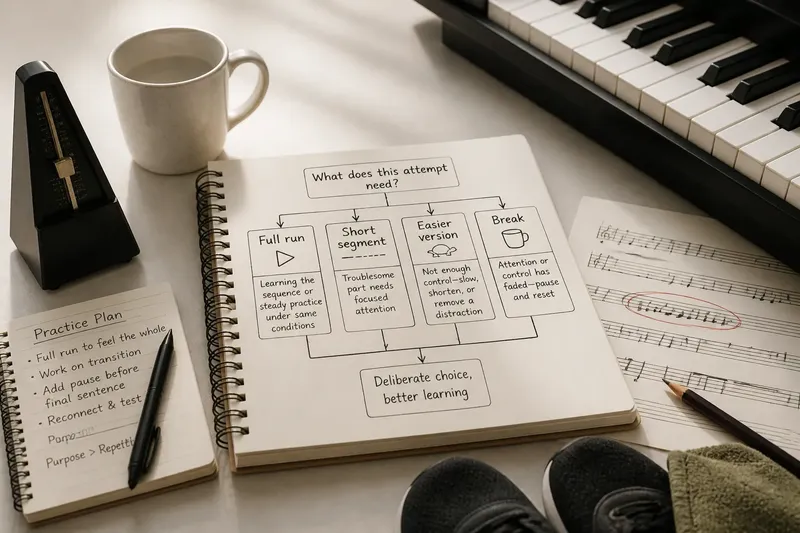
Once Maya can play the transition in context, she runs the piece from the beginning. This time, the run-through has a distinct purpose: check whether the passage fits the music around it, not whether every note is flawless. If the transition remains settled, she can direct later practice towards another marked passage; if it falters, she knows which component to inspect again.
For deliberate practice, treat a difficult passage as a small piece of music with distinct demands. Check the score, trace the movement, tap the rhythm and join the hands only when each part is clear. That gives the next practice choice a concrete basis, and makes the eventual full run more informative.