A First Week with a New Creative Skill
A first week with a new creative skill feels manageable when you choose one small outcome, protect a repeatable practice window and note one question.
The common mistake in a first week with a new creative skill is trying to learn the whole craft at once. You gather tutorials, buy supplies, and attempt a finished piece before you know what to practise. The cost is a crowded plan that is hard to return to. Keep the week small: choose one visible outcome, reserve a repeatable time and write down one question after each session.
This plan suits skills such as drawing, watercolour, knitting, creative writing, playing an instrument or learning a new handcraft. It is not a test of talent. By the end of the week, aim to have a modest piece of work and a clearer sense of what to explore next.
Choose a first-week outcome you can see
Pick an outcome that fits comfortably inside the week and can be recognised when it is done. “Learn to draw” is too broad. “Draw a mug from observation, using simple shapes and a visible shadow” gives you something to sit down and attempt. For a writing skill, you might draft one short scene built around a single character and place. For knitting, you might make a small square that lets you practise casting on and the knit stitch.
Keep the outcome focused on making something, not becoming good at the skill. A beginner’s piece may look uneven; that does not make it a failed outcome. You are giving your attention a destination, not setting a standard that demands polished work.
Write your outcome in one sentence and put it where you will practise. If the sentence needs several clauses to explain what counts, narrow the task. A sketch of one household object is easier to begin than an entire still life; one paragraph is easier to finish than a complete story.
Set a window you can repeat
Choose a practice window that already has a natural place in your day. It might follow breakfast, come just after work or happen before an evening activity. A repeatable cue helps you remember without needing to renegotiate your plan every day. Choose a time when you can give the work some attention, rather than the most ambitious slot on your calendar.
Make the practice space easy to enter. Leave a sketchbook and pencil on a clear table, keep your yarn and needles together in a basket, or place your instrument where it is ready to use if that is appropriate for your home. If you use a digital tool, open the project file and save the tutorial or reference you have chosen. Make sure your materials and setup follow their instructions and suit your circumstances.
Decide what counts as a workable session before the week begins. A session can be brief enough to fit a busy day, but it should include some direct contact with the skill: drawing lines, shaping a paragraph, practising a chord change or working a stitch. Watching another tutorial may help you prepare, but it is not a substitute for making something.
Keep a backup window in mind for a day that goes off course. That does not mean you need to make up every missed session. It means you can return at the next available opportunity without treating one disruption as a reason to abandon the week.
Use a gentle rhythm across the week
The schedule below gives each session a job without asking you to judge your progress every day. Adjust the timing and materials to suit your life. If you miss a day, continue with the next useful session rather than squeezing several into one evening.
- Day one: prepare and begin. Write down your small outcome. Gather only the materials you need for that task, then make an initial attempt. Notice what feels unfamiliar without stopping to research every difficulty.
- Day two: return to the same task. Start with a short look at what you made. Continue working towards the same outcome, and pay attention to one part of the process that you found awkward or uncertain.
- Day three: make a small variation. Repeat a useful part of the task, changing just one feature if that helps you notice it. A writer could try the same moment from another point of view; a drawer could observe a second object with a similar shape. Keep the variation close to your chosen outcome.
- Day four: leave room to miss a session. Use this as a rest or catch-up day, according to how the week is going. You do not owe the plan extra hours. If you practise, return to the original task rather than starting a new project.
- Day five: work on the part that raised a question. Choose one manageable point from your notes and give it attention in the next attempt. Avoid adding several new techniques at once; one question is enough to guide a session.
- Day six: bring the outcome together. Make a version that feels complete for a first week, even if it is rough. Resist restarting from scratch merely because you can see imperfections.
- Day seven: look back and choose what comes next. Put the week’s work together. Notice what you made, which session was easiest to start and what question you would like to carry into another week.
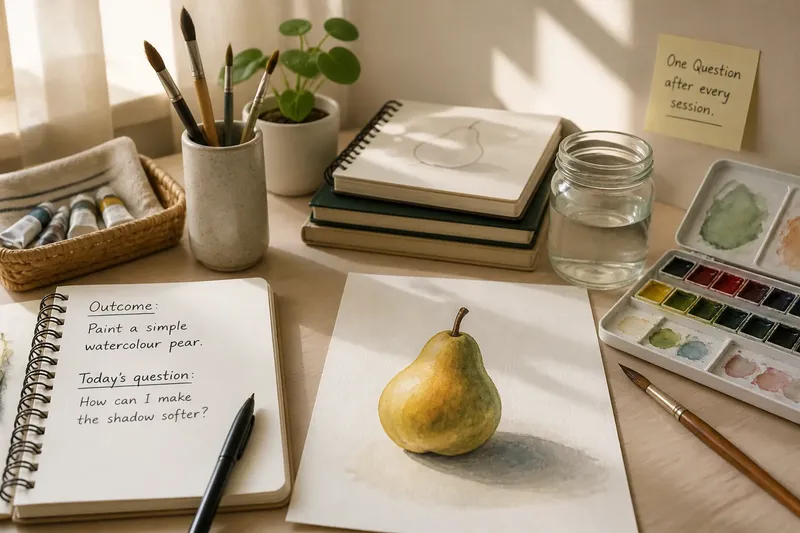
Say you want to learn watercolour and choose a small painting of a pear as your outcome. You reserve a familiar evening window, set out paper, brushes and paints, and use each session to work on the same subject. If you notice that the shadow is hard to judge, you write that down and return to it in a later session. By the end, you have a finished beginner’s painting and a specific question to guide your next practice, rather than a stack of unrelated exercises.
Record one question after every session
After you stop, write one question while the session is still fresh. Keep it brief and specific: “How can I make the mug’s handle look attached?” is more useful than “Why can’t I draw?” A writer might ask, “What makes this character’s reply sound hesitant?” A musician might note, “Where does my hand lose its place during this change?”
Do not turn the note into a list of faults. The point is to preserve the next useful uncertainty, not to pass judgement on yourself. If nothing stands out, write a question about the next part you want to understand. That still gives you a starting point when you return.
Keep all the questions in one place: a notebook page, a note on your phone or a document beside the work. On the next session, read the latest question before you begin. You may choose to explore it, or discover that a different issue is more immediate. The note is a prompt, not an order.
Keep the first week manageable when plans shift
A low-pressure plan needs room for ordinary interruptions. If you miss a window, do not double the next one to compensate. Return to the task at the next realistic opportunity and preserve the same small outcome. If the task now feels too large, reduce its scope: complete one section, study one shape or practise one transition.
If you feel stuck, distinguish between not knowing what to do and finding the work difficult. When you are unsure of the next action, consult one focused lesson or instruction and then return to making. When the action is clear but awkward, repeat it with attention and note what remains unclear. Opening a new course or changing materials can feel productive, but it may simply move the decision elsewhere.
Allow your first attempt to look like a first attempt. Put it beside your later work at the end of the week, not to score yourself, but to make your choices easier to notice. You might see that you returned to the task more readily, kept a line more controlled or found a sentence that says what you intended. Small observations are enough to inform the next week.
What should you do after the first week?
What if I miss a practice day?
Continue at the next suitable window and keep the outcome modest. You can use the planned rest day if it helps, but there is no need to fit every missed session into the remaining days.
Should I buy more materials before I begin?
Start with what is needed for your chosen outcome, using suitable materials you already have if possible. Consider buying something new only when a specific limitation in your current setup is stopping you from practising.
How do I know whether to repeat the same task?
Repeat it if another attempt would help you notice a useful detail or answer your recorded question. Change the task when the original outcome is complete or when a small variation would clarify the same skill.
What should I practise next?
Use the questions from the week, your finished work and your experience of starting sessions to choose one next focus. Keep the first-week outcome in mind, but select a fresh small piece of work so the practice has a clear direction.
Let the next week grow from what you noticed
At the end of the week, write down the outcome you completed, the question that still interests you and one detail that made practice easier to begin. Use those notes to shape the next small task. You might keep the same window, change it if it repeatedly clashed with your day, or prepare your materials differently.
The point of a first week with a new creative skill is not to prove that you can sustain an ambitious routine. It is to make one piece of work, learn what helps you return, and leave yourself a useful next question. Put that question beside your materials before you finish, so your next session has somewhere to begin.